
“En nuestro Portafolio compartimos resultados de investigación, bases de datos abiertas, aplicaciones interactivas y artículos académicos producidos por AVI-Lab y sus investigadores asociados. Todo el contenido está orientado a fomentar la transparencia, la innovación y la transferencia de conocimiento.”
Aplicaciones, Datasets y Herramientas
- Datasets públicos desarrollados por AVI-Lab.
- Blogs sobre resultados de investigaciones.
- Dashboards interactivos, visualizaciones o prototipos de IA.
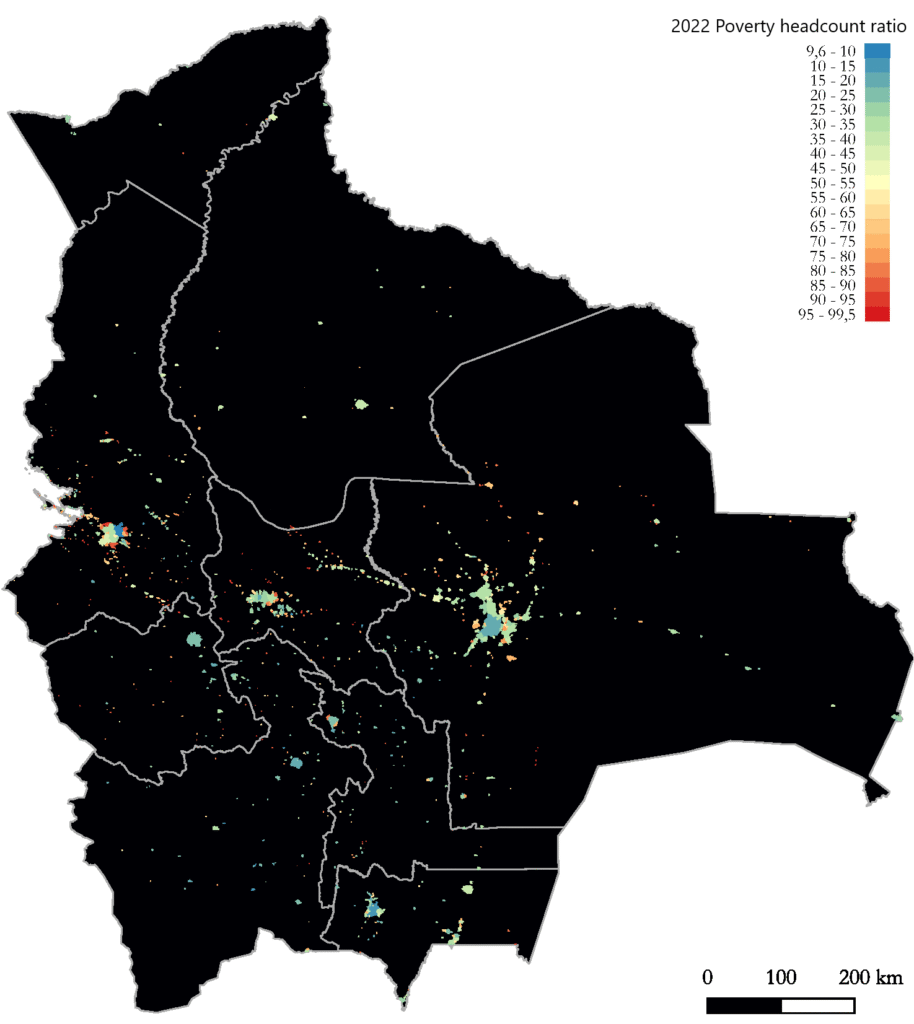
Combinando Machine Learning y Teledetección para predecir la Pobreza a Nivel Comunitario en Bolivia
Desarrollamos una metodología que integra machine learning y teledetección para estimar las tasas de pobreza a nivel comunitario en Bolivia. El estudio compara las condiciones del año 2012 y genera proyecciones para 2022, ofreciendo insumos valiosos para el diseño de políticas públicas inclusivas.
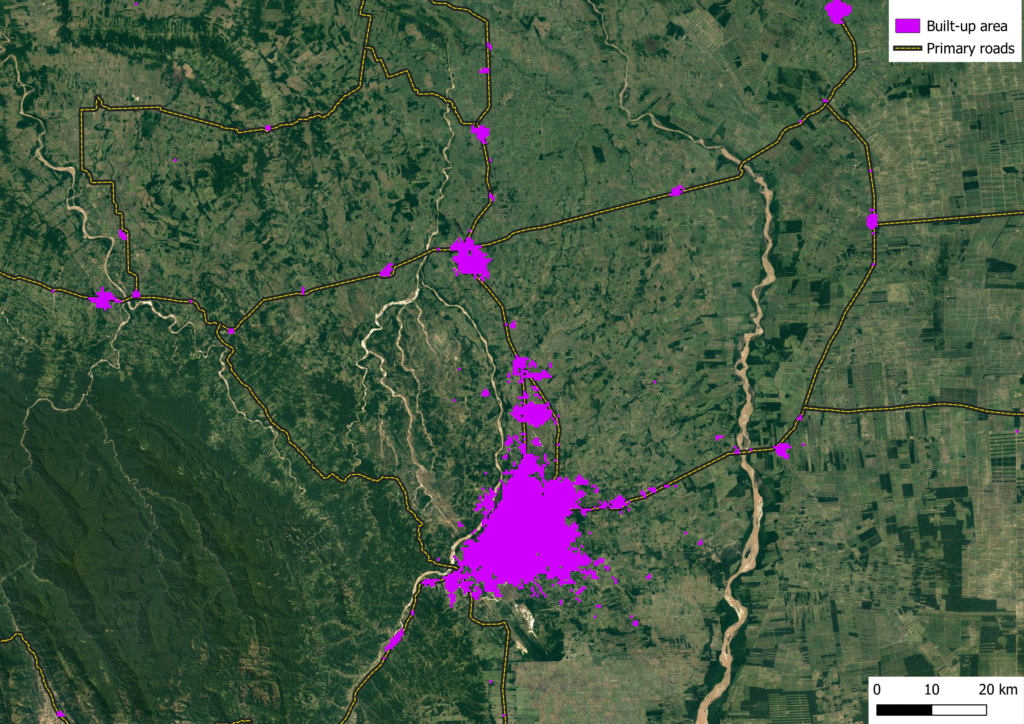
Áreas Urbanizadas de Bolivia
Presentamos una clasificación de las áreas urbanizadas en Bolivia utilizando técnicas de teledetección y machine learning (descargable en archivo raster). Este trabajo constituye una herramienta clave para el análisis económico, la planificación urbana y la gestión ambiental en el país.
Artículos de Investigación
Compartimos los últimos artículos en revistas o working papers producidos por AVI-Lab y sus investigadores asociados.
High-frequency inflation forecasting: A two-step machine learning methodolog
This study introduces a novel two-step machine learning methodology to generate high-frequency (daily and weekly) inflation forecasts in developing economies, where official statistics are typically available only at a monthly frequency and with delays. High-frequency forecasting here is interpreted as nowcasting or interpolation — real-time prediction ahead of official releases or within-period estimation using mixed-frequency indicators — while also serving as a data-augmentation strategy. In the first step, high-frequency predictors are aggregated to construct monthly-aligned features that serve as inputs for training machine learning models. In the second step, various feature selection techniques are evaluated and multiple machine learning algorithms are rigorously fine-tuned via hyperparameter optimization. Through systematic evaluation, a final model was selected — Ridge regression trained on an L1-regularized feature subset — that achieves superior out-of-sample accuracy. This model is then deployed to produce high-frequency year-on-year CPI inflation nowcasts. Forecasts exhibit strong temporal alignment with observed monthly values, while distributional equivalence — monthly vs. high-frequency projections — is confirmed via Kolmogorov–Smirnov tests. Compared to benchmark econometric models, the proposed approach delivers improved predictive performance, offering timely and granular insights for forward-looking monetary policy.
Sentiment, Cryptocurrency and Inflation: A Transmission Chanel in Bolivia
This paper examines the interplay between economic uncertainty sentiment, parallel cryptocurrency-based exchange rate, and inflation in Bolivia, leveraging high-frequency data and advanced econometric techniques. Following increased macroeconomic volatility from early 2023, Bolivia faced mounting pressure on its currency peg, leading to the rapid rise of stablecoins-particularly USDT-as alternative stores of value. Utilizing a dual methodological approach-a calibrated Dynamic Stochastic General Equilibrium (DSGE) model and a Bayesian Structural Vector Autoregression (BSVAR)-we identify a transmission mechanism where heightened uncertainty sentiment depreciates the parallel (digital) BOB/USDT exchange rate, amplifying inflationary pressures. Empirical impulse-response functions from daily data (January 2023 to April 2025) corroborate the model’s predictions, showing significant and persistent inflation effects driven by sentiment shocks. Moreover, our findings underscore the stabilizing potential of monetary policy, even within Bolivia’s constrained interest rate framework. This study offers critical insights for policymakers managing digital currency markets, emphasizing the need for real-time sentiment monitoring and proactive liquidity interventions to mitigate inflation risks.
Predicting community-level poverty in Bolivia: Insights from satellite imagery, census data, and spatial modeling
This study predicts community-level poverty headcount ratios in Bolivia for 2022, using a combination of machine learning, remote sensing, and spatial modeling techniques. By analyzing Unsatisfied Basic Needs (UBN) poverty in 953 communities between 2012 and 2022, the methodology successfully reveals a general decline in poverty rates, with approximately 50% of communities projected to fall below the 41.8% threshold in 2022. Notably, poverty reductions are more pronounced in communities with lower initial poverty levels, while regional disparities persist, with urban areas consistently exhibiting lower poverty rates. The approach demonstrates the effectiveness of combining machine learning and geospatial data to inform targeted poverty reduction strategies in Bolivia, offering a replicable model for other developing countries facing scarce and outdated high-resolution spatial data. This method provides valuable insights for policymakers seeking to address poverty at a granular level despite data limitations.
GDP Nowcasting: A Machine Learning and Remote Sensing Data-based Approach for Bolivia
This research introduces an innovative GDP nowcasting strategy tailored for developing countries, specifically addressing challenges related to limited data timeliness. The study centers on Bolivia, where the official monthly indicator of economic growth is released with a substantial delay of up to six months. The proposed nowcast estimates effectively narrow this gap from six to two months. This advancement is achieved through the integration of machine learning techniques with data comprising indicators from traditional sources and statistics derived from satellite imagery. The robustness of this approach is rigorously validated using various criteria, including performance comparisons with conventional econometric methods and sensitivity assessments to different feature sets. Beyond enhancing the understanding of Bolivia’s economic dynamics, this research establishes a framework for analogous analyses in regions grappling with information availability challenges.